Setting requester with a macro | The place for Zendesk users to come together and share
Skip to main content
Parked

Setting requester with a macro

Related products:Support
  • February 18, 2021
  • 40 replies
  • 112 views

We have a number of use cases where agents are creating tickets to the same requester quite frequently. It would be very useful for there to be an option to set requester with the macro actions. External CC's as well. 

What is the current technical limitation to this? Or just not something that seemed useful enough to implement?


40 replies

Kyle40
  • Employee
  • March 4, 2021

Hello there Amber,

For clarity, is it alway the same requester? If so, you could potentially put that requester's email in the macro for your agents to cut/paste into the requester field to make it easier to find them. Additionally, the side-bar field should auto-fill requesters when you start typing them.

Sadly, I couldn't find any news about this being on a potential road-map, so I can't confirm if this feature is being worked on or looked at. However, any further details about why this would be needed within your work-flow could potentially offer our Product Team a bit more insight.

I hope this helps,


  • August 12, 2022

My company could use this as well. One example is for us to email an outage distribution list in our company when there are outages. If we use a target in the trigger and someone responds it creates a new ticket (which is a real problem since Zendesk does not have a BCC option so it adds our distribution list as a CC on that new ticket), so we created an end-user with the distribution list for their email address. We then set the requester to that end user and use the trigger to email the requester so any replies to the outage email will go to the correct ticket. It would be really nice to have our outage macro set the requester to the distribution list's end user (the workaround Kyle suggested isn't the best, especially when you factor in the possibility of human error at the beginning of a major outage). For now, we use something similar to this to make it work:
https://support.zendesk.com/hc/en-us/articles/4416465281434-Announcing-security-improvement-for-CCs-in-follow-up-tickets-created-via-email#:~:text=dschmidt,August%2012%2C%202022


  • September 15, 2022

@kyle40 any news on this? We previously used another ticketing system which allowed to set the requester/recipient of the ticket.

We create tickets to contact specific instances of some of our partners to perform some changes, it would be very helpful and make the process more efficient if there was a way to set the email directly instead of having to process it manually each time


Nicolas30
  • October 7, 2022

@kyle40 any update for this feature request or an ETA? Thanks


  • October 25, 2022

This is a feature that is definitely required within our business workflows. Following


Patrick61
  • January 24, 2023

+1, I'm also looking for a way to do this.


  • March 24, 2023

This is something that would be beneficial for our org as well. 


Same here! 


  • April 25, 2023

+1


Scott17
  • Employee
  • April 28, 2023

Thank you everyone for continuing to share your needs for this. Unfortunately, this is not on our roadmap for this year, so I will update the status as Not Planned for now.

It's possible we'll prioritize this in the future, as it's really all down to customer demand. This year we've prioritized investments in other areas, such as SLAs. Next month we're launching Group SLAs at Relate, with further enhancements for SLAs coming later this year.

Thanks again for your continued feedback, it's really appreciated.


  • June 7, 2023

+1


We definitely need this in our instance. I have a process where I need to send a notification to an agent either via a trigger or automation but the built in rules do not allow a notification to be sent to an agent CC (we currently haven't switched to the follower experience) or agent follower (once we do switch) using business rules. Being able to set the requestor via macro would resolve this. 

I need a process where I can send automated chasers to agents that are either CC's or followers and I have been trying for over a year. 


  • August 8, 2023

For us as well this option would be really helpful. 

We frequently receive requests that are forwarded to the same mail address. 

So automatically adding the address via macro would make this daily task easier. 


Hello, +1 for the feature to be able to set the requester in a macro

thank you, 


Adam62
  • December 6, 2023

+1


  • January 9, 2024

Hi, 

This is something that would increase the handling times with the possibility to add external requesters. Same as you can already to in Side conversation E-mail.


It's often you have requesters (end users) with similar mailadresses and names which takes even more time to search for them and start a new ticket. 


Jason81
  • January 10, 2024

+1


  • February 12, 2024

Would certainly speed up replying to multiple tickets allot quicker! +1


  • March 14, 2024

+1


  • March 19, 2024

+1


  • April 18, 2024

+1


  • April 27, 2024

+1


Stefane
  • May 16, 2024

+1


  • May 30, 2024

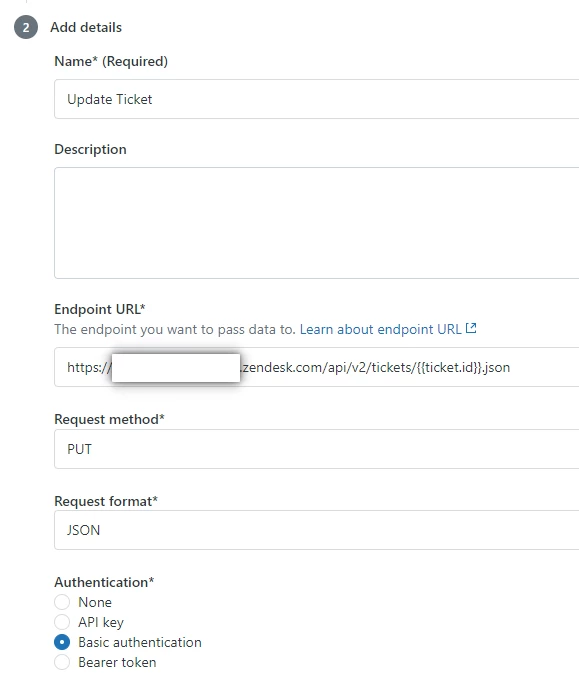
Hello, here's how we figured out to update the requester to the end user CC'd.

Our use case: We create tickets on behalf our customers and we don't want them to see it because it maintenance.

So we email our support email and CC the dummy end user we have for that organization.

The the trigger runs based on received at abc@zendeskdomainemail.com & ticket is created.

  • Have/create a Webhook to update the ticket – Screenshot below.
  • Trigger JSON code:

{
   "ticket": {
       "requester_id": "{% for cc in ticket.ccs %} {{cc.id}} {% endfor %}"
   }

}


Webhook: (add your domain where my white block is).


Hope this helps others for the immediate need!


Nate20
  • June 20, 2024

This would be really helpful for our team as well! 


Or, if anyone has recommendations for something like an internal ticket? We do not need a requester on these, but simply create a ticket as a placeholder for maintenance and updates internally.